

All Blogs
AI & Technology
August 5, 2026
Sustainability reports have a new reader, and it isn't skimming for the highlights. AI models, including the large language models embedded in ESG rating platforms and disclosure benchmarking tools, are now parsing corporate sustainability reports directly, extracting metrics, and scoring completeness against frameworks like CDP, CSRD, and GRI.
The problem: most reports are still designed for a human reader flipping through a PDF, not for a model chunking text and matching it to a taxonomy. If your data isn't structured for AI to find, read, and extract, you risk losing credit for disclosures you've already done the work to produce.
Here are four practical, testable fixes.
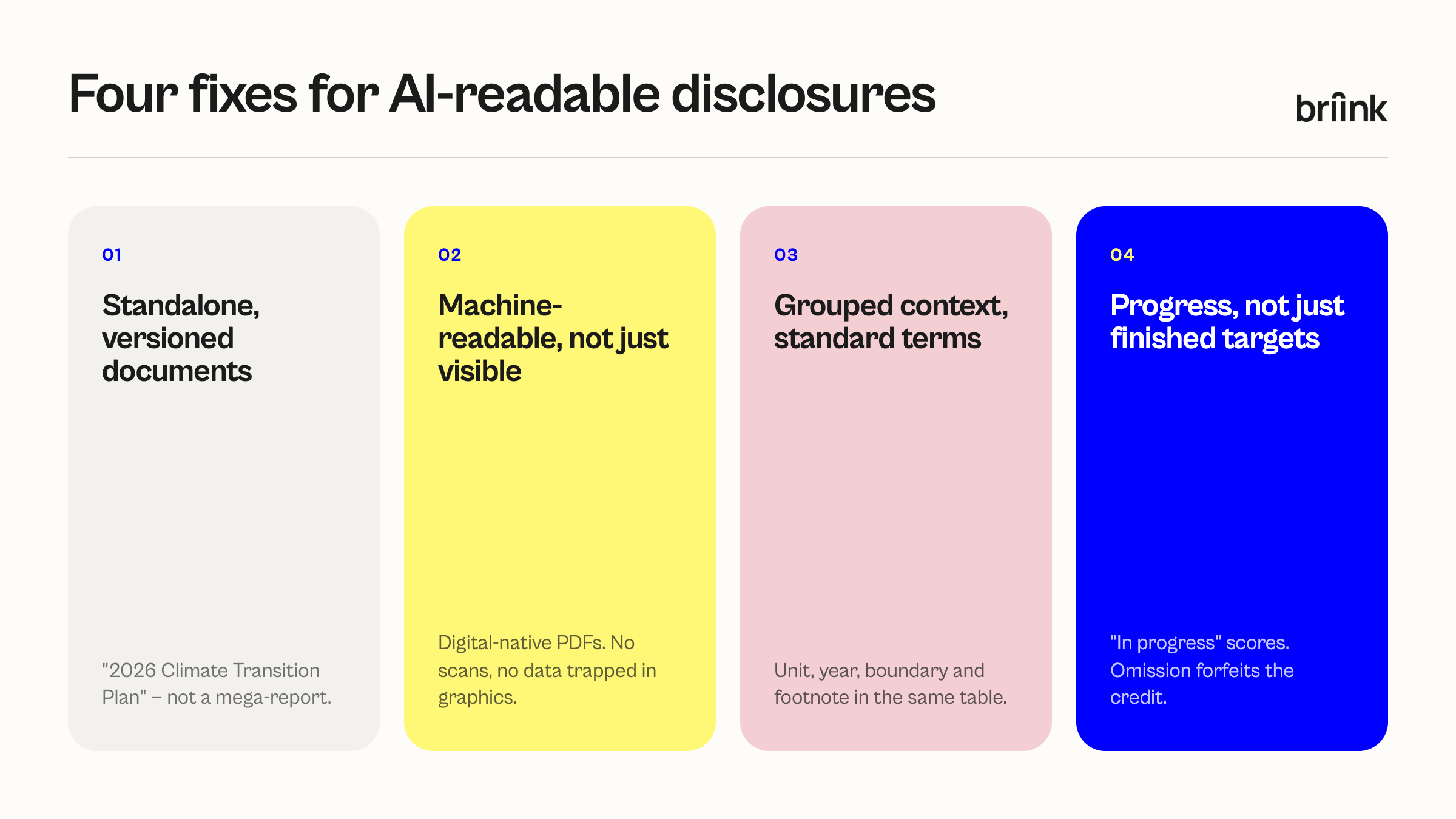
1. Publish Disclosures as Standalone, Versioned Documents
AI has to find your data before it can analyze it. Standalone, clearly versioned PDFs consistently outperform website-only content or disclosures buried inside a single 150-page annual report.
What works:
- Descriptive, specific titles: "2026 Climate Transition Plan," not "Sustainability Update"
- Clear version dates, so a model can detect that a policy changed year over year. A silent website edit is often missed entirely; a labeled "2026 version" is not.
- Framework-specific documents (a standalone Supplier Code of Conduct, a standalone TCFD index) rather than one mega-report covering everything
What to avoid:
- Burying a framework-specific policy inside a general annual report
- Relying on a single document as your only disclosure surface
- Scattering related disclosures across multiple, disconnected web pages
2. Make Content Machine-Readable, Not Just Visible
Once a model finds your report, the content has to be extractable, not just visible to a human eye.
- Export as digital-native PDFs, directly from your publishing tool, not as scanned images. Scanned pages require OCR, and not every AI system runs it reliably at scale.
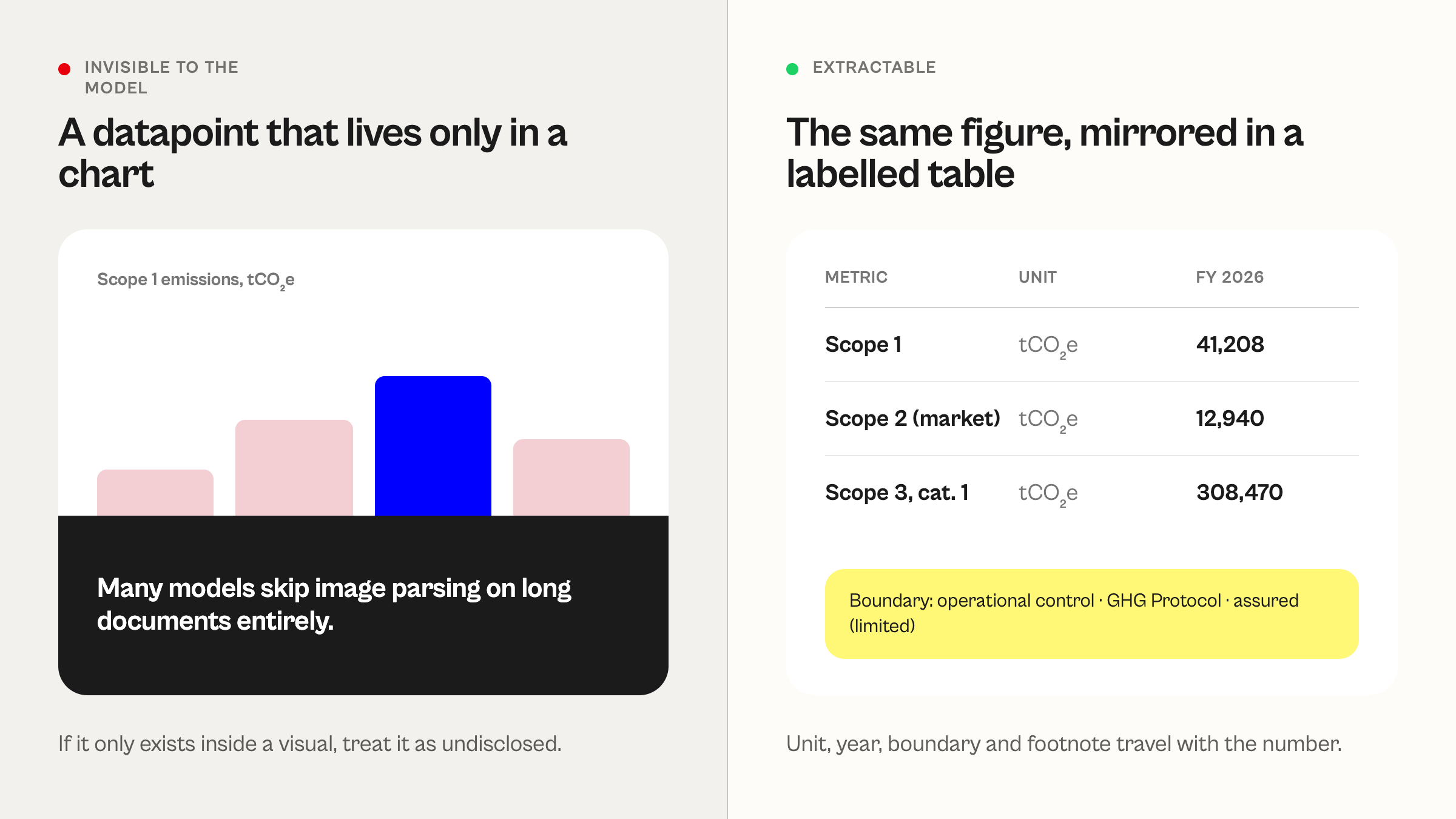
- Don't let your key data live only in graphics. Waterfall charts and infographics read well to people, but many AI models skip image parsing entirely on long documents, since scanning every visual in a large report is computationally expensive. If a datapoint only exists inside an image, treat it as undisclosed for AI purposes.
- The fix: mirror every critical datapoint from a visual in a labeled table or in the surrounding narrative text.
3. Group Context, and Standardize Terminology
AI tools process documents in chunks. A metric extracted without its context is often a metric extracted incorrectly.
- Keep related fields together. A Scope 1 emissions figure needs its unit, reporting year, scope boundary, and footnotes in the same table or section, not spread across the document.
- Use framework-standard terms. Rating models are trained heavily on IFRS, CSRD, and GRI language. If it's a Climate Transition Plan, don't rename it a Climate Action Plan for internal reasons; the model won't map the two.
4. Disclose Progress, Not Just Finished Targets
Companies often omit a topic entirely if a target isn't finalized or the data isn't perfect, which reads as a gap in AI-driven completeness scoring, even when real progress exists.
- State direction, not just destination. If a target isn't final, say so, and describe where you are.
- Use transparent status language: "in progress," "under development," "initial assessment completed." These are real signals that scoring models pick up, and they capture partial credit that a total omission forfeits.
The Underlying Shift
None of this is about writing for machines instead of people. It's about recognizing that structure, consistency, and traceability, the same qualities that make a report auditable for a human reviewer, are exactly what make it legible to an AI system. Reports built this way tend to perform better with both readers.
Related Articles



Build Once. Reuse
Every Cycle.
Use AI to extract, structure, and reuse ESG data across CDP and beyond. Get ready for AI-powered pre-filling in the 2026 disclosure cycle.