

All Blogs
AI & Technology
May 21, 2026
The promise of AI in ESG reporting has never been louder. But as sustainability teams experiment with tools like ChatGPT and Copilot, a critical gap is emerging: general-purpose AI was not built for ESG work, and it shows.
At Briink, we've spent years building AI infrastructure specifically for ESG and sustainability data. The difference between purpose-built ESG AI and a generic large language model (LLM) isn't just technical. It's the difference between a tool that helps and one that creates new problems.
The Allure (and Limits) of Generic AI
Generic LLMs are impressive. They can summarize documents, draft text, and answer questions across almost any domain. For many tasks, they're genuinely useful.
But ESG reporting is not a general task. It's a highly structured, high-stakes workflow that demands:
- Precision, not approximation. Every data point must be traceable to a source.
- Framework awareness. CDP, ESRS, EcoVadis, and others each have specific logic, scoring mechanisms, and conditional requirements.
- Consistency. Answers need to align across disclosures and across years.
- Auditability. Regulators and rating agencies expect evidence, not AI-generated summaries.
Most generic LLMs fail on all four counts. They hallucinate. They have no awareness of ESG framework rules. They don't know your documents from last year's reporting cycle. And when they guess, there's no citation to back it up.
What "Specialized" Actually Means
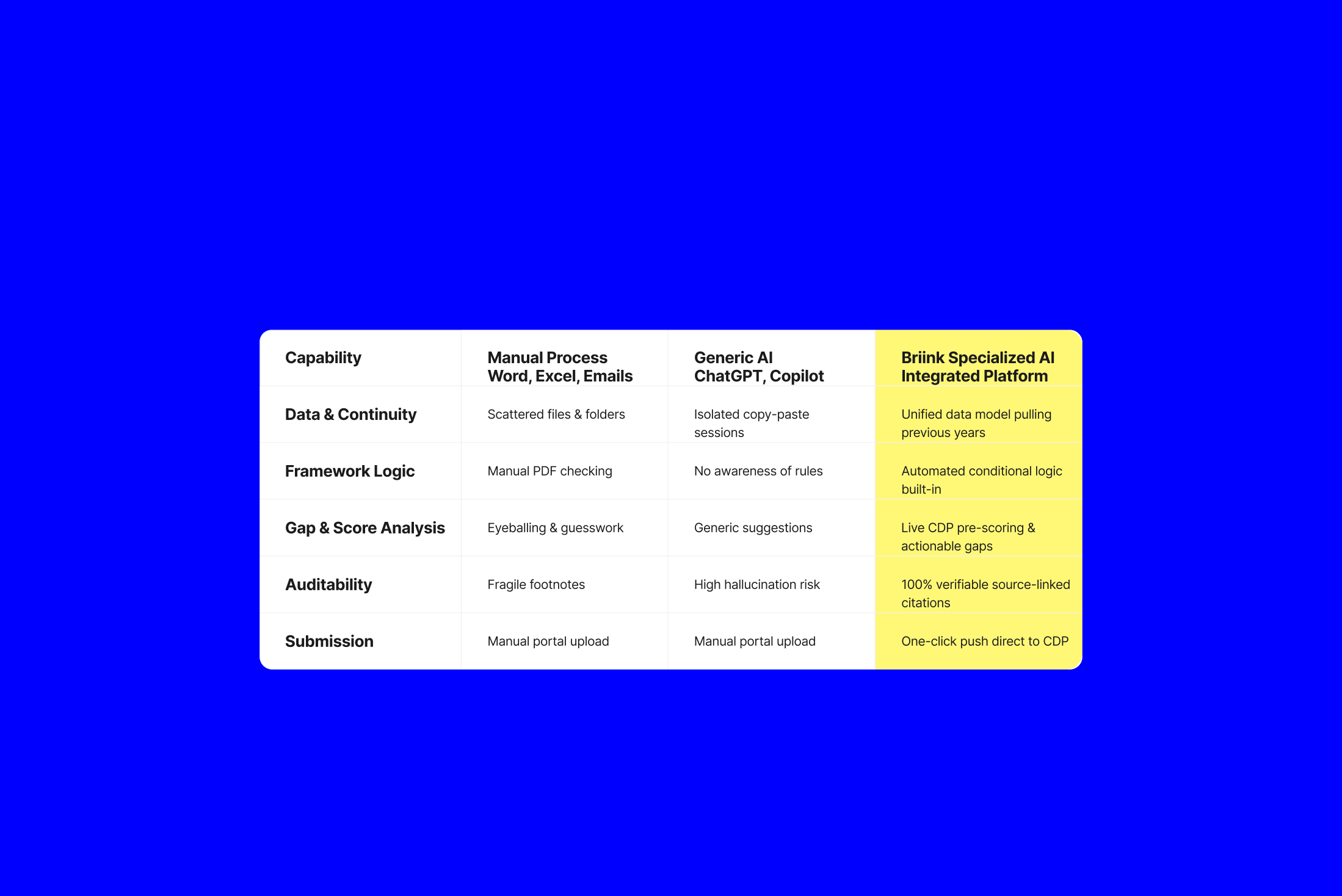
Specialized AI isn't just a generic model with an ESG label. It's a system built from the ground up around the specific data, logic, and workflows that ESG teams deal with every day. Here's how the difference plays out in practice across five critical capabilities:
1. Data & Continuity
Generic AI: Each session starts from scratch. Teams copy and paste from scattered files, and there's no memory of previous years' submissions or existing ESG data.
Briink: A unified data model connects your current documents with prior disclosures. Teams don't start from zero, they start from a structured, centralized knowledge base that carries forward what was already verified.
2. Framework Logic
Generic AI: No awareness of the rules. ChatGPT doesn't know that CDP Climate questionnaires have conditional dependencies, or that specific ESRS datapoints require quantitative evidence. It treats every question as a blank text prompt.
Briink: Automated conditional logic is built directly into the platform. The AI understands which questions are triggered by which answers, what evidence is required, and how each framework scores responses.
3. Gap & Score Analysis
Generic AI: At best, generic suggestions. At worst, false confidence. Teams believe they've answered well, only to find gaps after submission.
Briink: Live pre-scoring and actionable gap identification. Before submitting responses for verification, teams can see exactly where they stand, which answers are weak, and what evidence would improve their score. This is only possible because the AI understands the scoring methodology.
4. Auditability
Generic AI: High hallucination risk. Generic models confidently produce answers that sound correct but aren't traceable to any actual document. In ESG reporting, this isn't just inconvenient, it's a liability.
Briink: Every answer is backed by a verifiable source citation, linked to the exact document and page number. 100% source-linked outputs mean teams can defend every data point to auditors, rating agencies, and regulators.
5. Submission
Generic AI: Even after generating draft answers, teams still face manual copy-paste into disclosure portals creating errors and adding hours of work.
Briink: As CDP's AI partner for 2026 disclosures, Briink enables a seamless, one-click push from preparation to submission. Eliminating the final bottleneck in the reporting cycle.
The Bigger Picture: Why Domain Expertise Changes Everything
There's a principle at the core of Briink's approach: AI is only as good as the context it can work with.
Generic LLMs rely on latent knowledge, everything they've absorbed from pre-training. This makes them dangerous for ESG work, because they'll fill gaps with plausible-sounding but ungrounded answers. Briink deliberately avoids this. The AI is grounded in your documents, your prior submissions, and your specific disclosure requirements, not in general internet knowledge.
This also means Briink stays on target. If you ask it to answer a question using three specific documents, it uses those three documents. It doesn't import information from other sources or make assumptions beyond what's there. If the answer isn't in your materials, it says so, rather than inventing one.
The implications extend beyond accuracy. ESG teams that use general AI tools often spend significant time checking AI outputs. Fact-checking, re-reading source documents, correcting hallucinations. With specialized AI, that verification burden drops dramatically because the outputs are already grounded and cited.
The Cost of Getting This Wrong
ESG reporting errors are not just embarrassing, they have regulatory and reputational consequences. As frameworks like CSRD and ESRS become mandatory, the bar for accuracy and auditability is rising fast.
Teams that rely on generic AI to navigate this complexity are taking on risks they may not fully see yet. When a rating agency queries a data point, "ChatGPT generated it" is not an acceptable response.
Specialized AI shifts the calculus entirely. It doesn't just help teams go faster, it helps them go faster with confidence.
The Briink Difference
Briink was built for exactly this moment. As ESG disclosure requirements multiply and sustainability teams are asked to do more with less, the answer isn't a generic chatbot bolted onto existing workflows. It's AI that understands the frameworks, speaks the language of ESG, and produces outputs that can actually be submitted, audited, and defended. The comparison isn't close. Specialized AI doesn't just outperform generic LLMs, it operates in a fundamentally different category.
Ready to see it in action? Book a demo with Briink →
Briink is an AI-powered ESG disclosure and sustainability data automation platform. As CDP's selected AI partner for 2026, Briink helps organizations across Europe and beyond automate questionnaire pre-filling, gap analysis, and ESG data extraction, with full source traceability.
Related Articles



Build Once. Reuse
Every Cycle.
Use AI to extract, structure, and reuse ESG data across CDP and beyond. Get ready for AI-powered pre-filling in the 2026 disclosure cycle.